
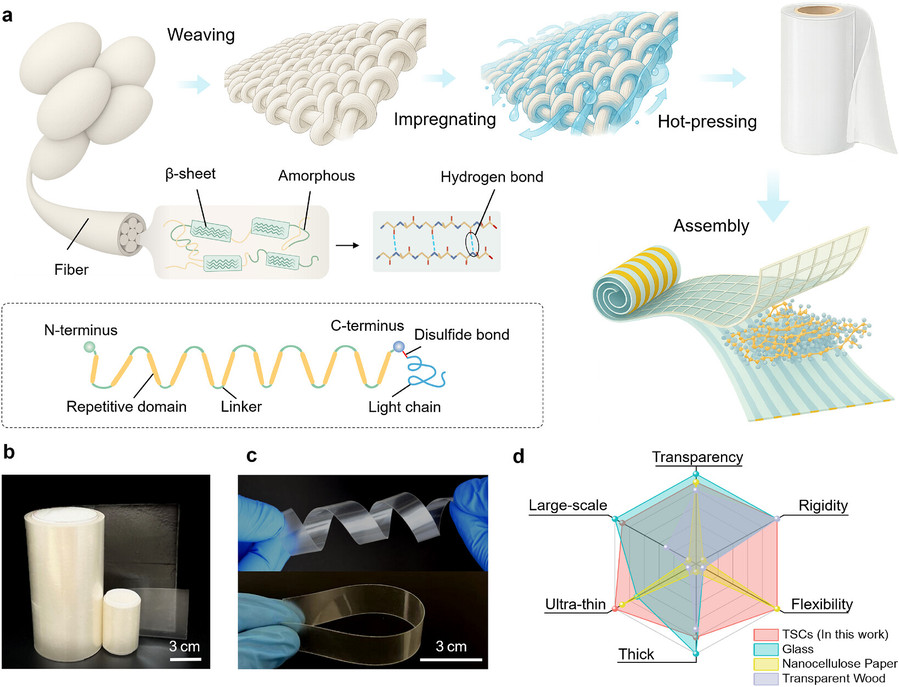
Transparent and impact‐resistant films are critical for applications ranging from architecture and transportation to photovoltaics and optoelectronics. Yet conventional glass and petroleum‐based plastics suffer from brittleness, limited optical‐mechanical synergy, and sustainability challenges. Here we present transparent silk fabric/epoxy composites (TSCs), fabricated by refractive‐index matching, pore infiltration, and interfacial densification through an integrated VARTM‐hot‐press process. Thus, the TSCs offer high transmittance (up to 90%) and tunable haze (0.04–43%). With a fracture energy of 166 kJ m⁻² and a fracture toughness of 25.5 MPa·m1/2, they demonstrate exceptional toughness, surpassing known transparent materials. Multiscale characterization and finite‐element analysis reveal synergistic toughening mechanisms including crack deflection, fiber bridging, and stress redistribution. Beyond mechanical reinforcement, the woven scaffold imparts anisotropic forward scattering that enables tunable light‐field shaping, enhancing illumination uniformity and photovoltaic harvesting. Device‐level tests confirm improved power conversion efficiency (∼10.5% relative gain) and stable charging in practical scenarios, while durability studies demonstrate long‐term stability under water, UV, mechanical, and soil conditions. Together, these results identify TSCs as scalable, sustainable alternatives to glass and plastics, bridging the transparency‐toughness trade‐off and offering new opportunities for light management in next‐generation energy and infrastructure systems.
Copyright © 上海复旦大学

