
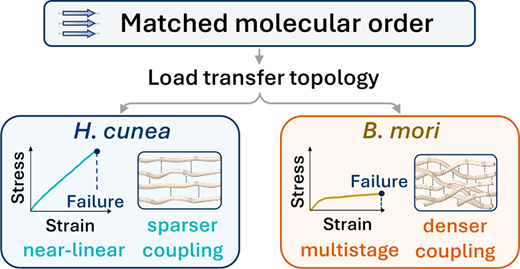
The mechanical response of silk fibers is commonly associated with β-sheet crystallinity and molecular orientation, yet how these molecular descriptors are transmitted across the fibrillar hierarchy remains less clear. Here, we compare Hyphantria cunea silk with Bombyx mori silk to examine how nanofibril-level load-transfer descriptors are associated with deformation when β-sheet fraction and axial orientation are comparable. Peptide profiling and single-fiber synchrotron infrared microspectroscopy show that H. cunea silk contains β-sheet-compatible sequence motifs and reaches β-sheet content and axial orientation comparable to those of B. mori silk. Despite this similarity, H. cunea silk exhibits a high-strength, near-linear tensile response, whereas B. mori silk follows a yielding−extension−hardening pathway. AFM-based fibrillar analysis and topology-constrained load-transfer modeling identify systematic differences in ex situ contour characteristics, effective coupling, and characteristic load-transfer descriptors that are consistent with the observed mechanical divergence. These results identify nanofibril coupling topology as a structural descriptor for programming silk fiber deformation beyond β-sheet order.
https://doi.org/10.1021/acs.biomac.6c01384
Copyright © 上海复旦大学

