
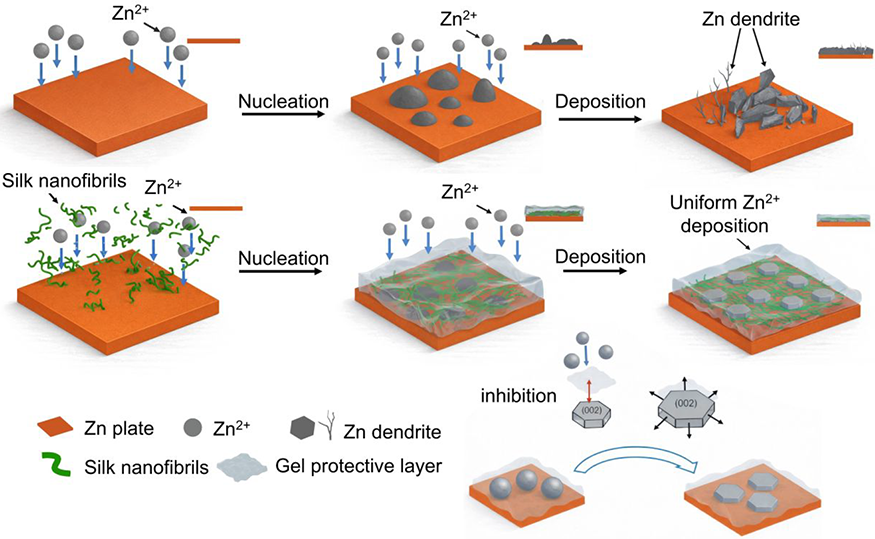
The development of aqueous zinc-ion batteries (AZIBs) is hindered by challenges such as zinc dendrite growth, parasitic side reactions, and zinc corrosion during cycling. Employing electrolyte additives to form a protective layer on electrodes represents an effective strategy to mitigate these issues. Natural biomaterials are increasingly attracting attention as environmentally friendly alternatives to conventional toxic additives. This study investigates “top-down” silk nanofibrils (TD SNF) and “bottom-up” silk nanofibrils (BU SNF), prepared via different processing methods, as functional additives. These two types of silk nanofibrils (SNF) display distinct behaviors depending on the electrolyte system. In ZnSO4 electrolyte, both types of SNF aggregate into microgel particles. Conversely, in Zn(OTF)2 electrolyte, BU SNF maintains its nanofibrous structure and forms a homogeneous hydrogel network. These SNF form a protective gel layer on the Zn anode surface, which modulates zinc nucleation and growth. As a result, the TD SNF additive in ZnSO4 electrolyte enables stable cycling for 2750 h at 2 mA cm−2 with a capacity of 2 mAh cm−2. Similarly, the BU SNF additive in Zn(OTF)2 achieves a cycle life of 700 h under more demanding conditions of 10 mA cm−2 and 10 mAh cm−2. This work provides insights into the application of SNF as sustainable electrolyte additives for high-performance AZIBs.
https://doi.org/10.1021/acsaem.6c00742
Copyright © 上海复旦大学

