
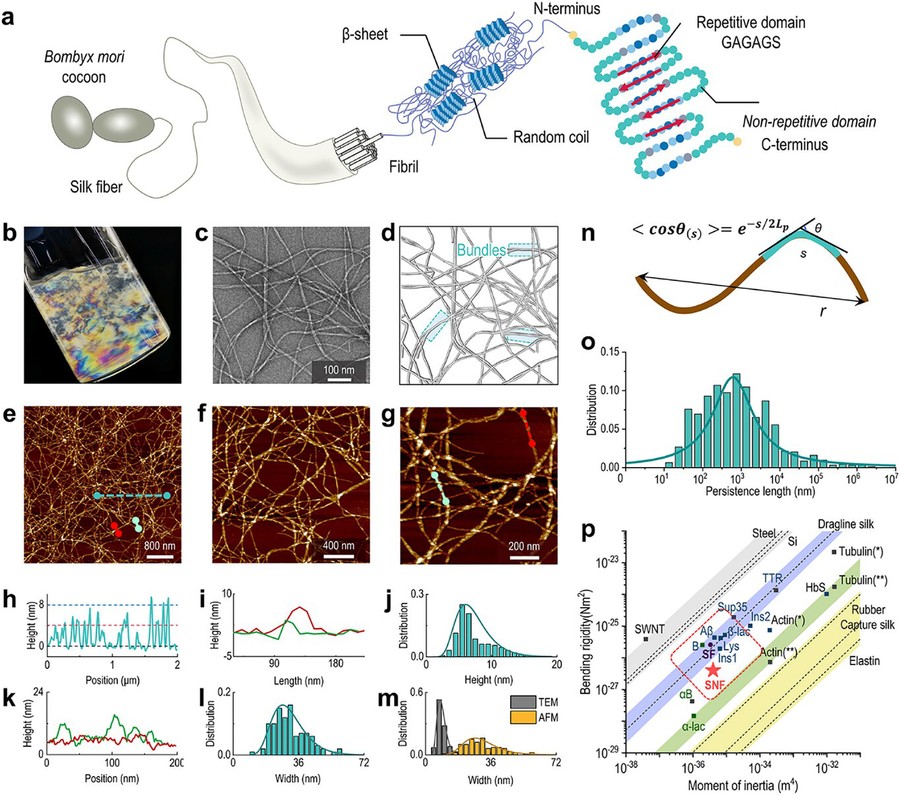
The remarkable mechanical properties of silk fibroin originate from its hierarchical fibrous architecture spanning multiple length scales; however, how these intricate networks precisely govern macroscopic mechanical behavior remains incompletely understood. Here, experimental characterization with computational modeling is integrated to elucidate the structural and molecular mechanisms underpinning silk fibril network formation and mechanical function. High‐resolution imaging coupled with deep‐learning‐based morphological extraction enables precise quantification of critical architectural features within the networks. Coarse‐grained molecular dynamics simulations reveal that network mechanical properties and stability are predominantly governed by interfibrillar interaction strengths, with hydrophobic forces identified as the primary molecular drivers of fibril bundling. Specifically, weak interfibrillar cohesive interactions result in flexible and deformable networks under applied stresses, whereas strong interactions induce excessive fibril aggregation, reducing structural adaptability and leading to premature mechanical failure. Simulations under spatially confined conditions, mimicking natural spinning processes, further clarify mechanisms essential for fibril alignment. This study significantly advances the fundamental understanding of silk's structure–property relationships, providing valuable guidelines for designing and precisely controlling silk‐based materials for biomedical and structural engineering applications.
https://doi.org/10.1002/adfm.202525857
Copyright © 上海复旦大学

