
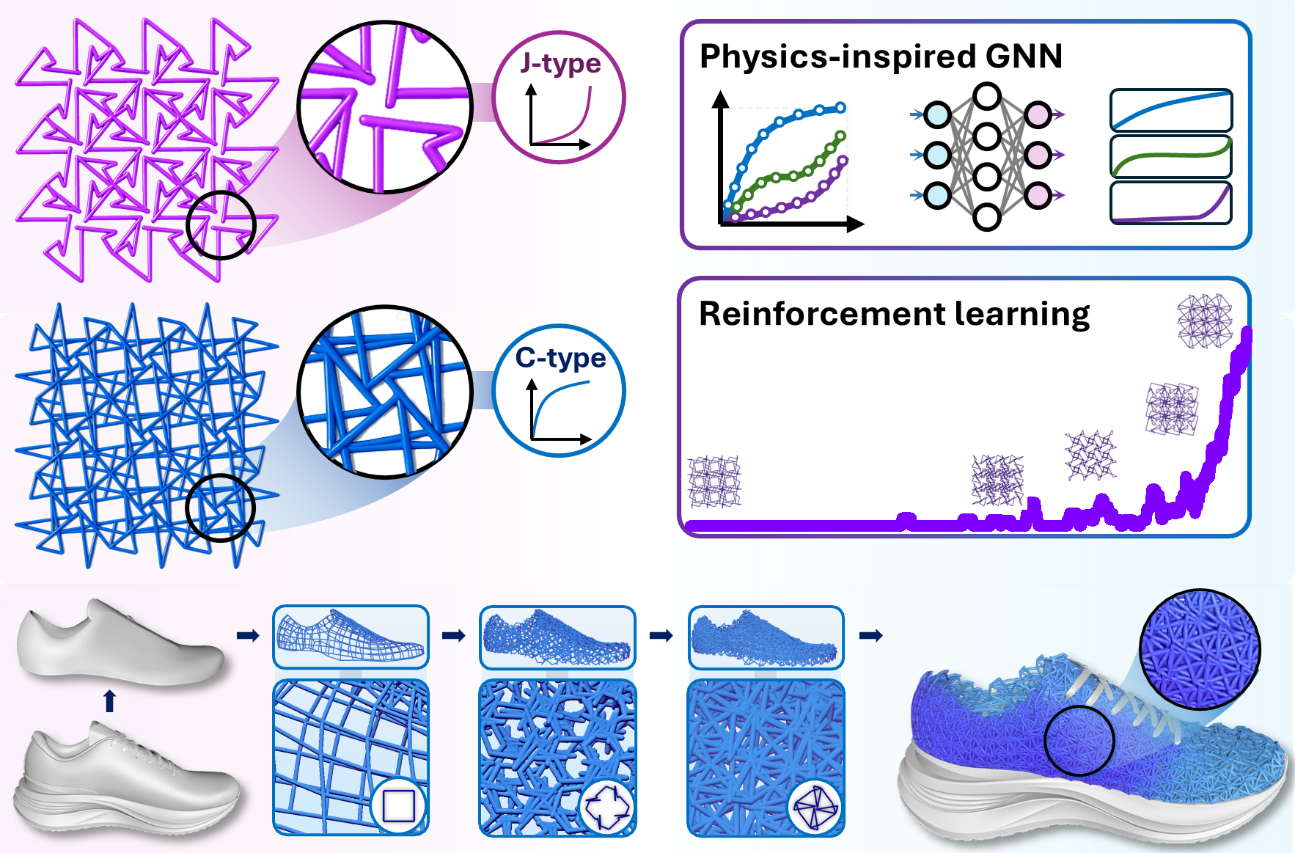
Designing fibrous network materials that are simultaneously high-performance and manufacturable remains a fundamental challenge due to the complex coupling between topology, mechanics, and fabrication constraints. Here, we introduce the Regular Fibrous Network Framework, a manufacturability-informed and physics-consistent artificial intelligence framework that bridges digital topology, mechanical prediction, and physical realization. Within this framework, the Topology-Preserving Network Construction algorithm formalizes Eulerian circuit continuity for single-fiber fabrication and transforms digital topologies into knitting- and three-dimensional-printing-compatible architectures. An automated finite-element-analysis pipeline and a physics-inspired graph neural network accurately capture nonlinear J-type and C-type load-displacement behaviors, while a reinforcement learning module performs inverse design within minutes, achieving approximately 50% higher strength and approximately 20% lower mass compared with initial designs. Extending the framework with QuadriFlow-based surface mapping enables direct projection of optimized two-dimensional networks onto curved three-dimensional geometries. This approach is experimentally validated through stereolithography and fused deposition modeling. By integrating manufacturability constraints, physics-inspired learning, and artificial-intelligence-driven optimization into a unified pipeline, the proposed framework provides a generalizable paradigm for knittable, printable, and programmable fibrous network materials, offering a pathway toward autonomous and high-efficiency design of architected materials across length scales.
https://doi.org/10.1038/s41467-026-76045-x
Copyright © 上海复旦大学

