
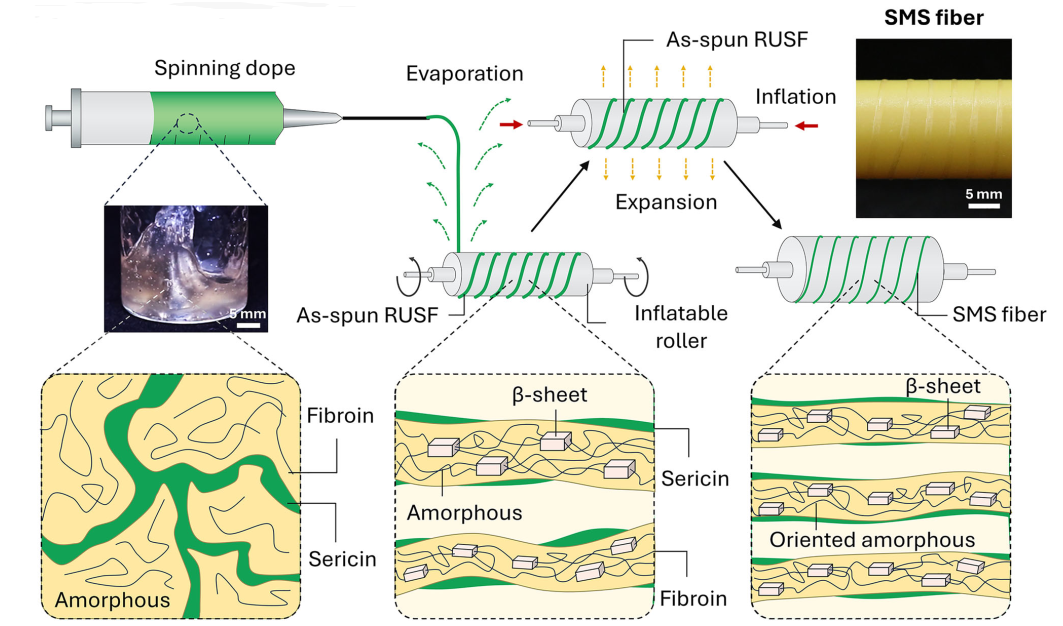
Soft fibrous materials that integrate mechanical robustness with efficient electrical and optical signal transport are highly desirable for intelligent wearables, yet remain challenging due to the intrinsic trade-off between structural reinforcement and functional transport. Here, inspired by natural silk spinning, we introduce a processing-history programming strategy that exploits the controlled coupling of humidity, stretching, and dehydration to encode multifunctionality into silk-based fibers without chemical modification. Through a humidity-assisted stretching-mediated spinning (SMS) pathway, hierarchical structural reconstruction is synchronously induced, featuring enhanced β-sheet formation, increased axial orientation, and a radially graded architecture, which together lead to orders-of-magnitude improvements in strength, modulus, and toughness. Importantly, the mechanically reinforced fibers preserve continuous ionic transport pathways and exhibit stable electromechanical responses, while also functioning as visible-light waveguides with optical transmission. By integrating multimodal electrical and optical signals with on-device machine learning, the fibers enable real-time decoding of human motion states and sweat electrolyte concentrations, establishing processing-history programming as a general paradigm for designing multifunctional fibrous electronics and intelligent textiles.
https://advanced.onlinelibrary.wiley.com/doi/10.1002/adfm.76164
Copyright © 上海复旦大学

