
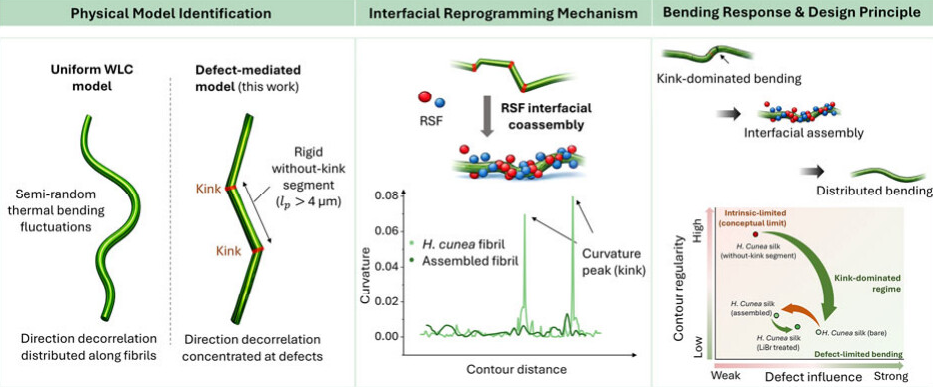
Rigid biogenic nanofibrils are generally understood through their backbone structure, crystallinity, and molecular alignment, whereas the role of sparse geometric defects in governing whole-fibril mechanics remains less clear. Here, we show that highly rigid Hyphantria cunea silk nanofibrils contain intrinsic kink defects that dominate contour-level orientational decorrelation and govern the defect-mediated bending response of the fibril. These localized angular discontinuities interrupt otherwise straight rigid segments and produce contour statistics that cannot be captured by uniform thermal bending alone. Interfacial assembly of regenerated Bombyx mori silk fibroin on the nanofibril surface progressively suppresses kink expression, smooths contour curvature, and shifts the bending mode from kink-dominated segmented reorientation toward distributed bending. Selective removal of the assembled interfacial layer partially restores the original high-curvature features and defect-mediated bending state, demonstrating that the effect is largely reversible and arises from contour statistical redistribution rather than permanent modification of the rigid backbone. Our results establish interfacial assembly as a route to reprogram defect expression in rigid biogenic nanofibrils and thereby tune single-fibril bending mechanics. This framework may provide broader insight into interface-controlled mechanics in other high-aspect ratio biogenic fibrillar systems.
https://pubs.acs.org/doi/10.1021/acs.langmuir.6c01691
Copyright © 上海复旦大学

