
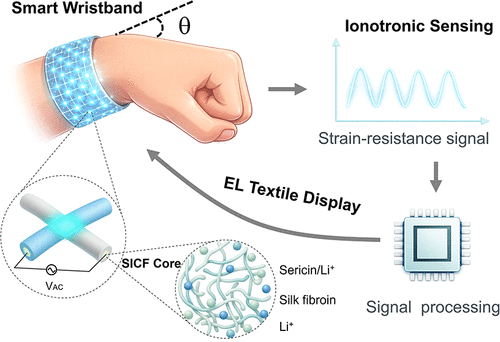
Natural silk spinning exemplifies a pathway-dependent material construction, in which soft protein precursors are transformed into fibers that combine high strength, toughness, and functionality under mild conditions. Replicating such a pathway-governed integration in artificial fibers, particularly while enabling functional conductivity and device compatibility, remains challenging. Here, we report a biomimetic, pathway-guided wet-spinning strategy to construct multicomponent silk-based fibers that integrate mechanical robustness with high ionic conductivity. By directly dissolving undegummed silkworm cocoons, we establish an intrinsically multicomponent spinning dope that undergoes mesoscale preorganization and traction-dominated solidification. This process converts preorganized structures into an oriented fibroin nanofibrillar scaffold while preserving a continuous, reconfigurable interfacial network enriched in sericin and ionic species. The resulting fibers exhibit a balanced combination of strength, stiffness, and toughness, together with ionic conductivity comparable to soft ionic conductors. Importantly, stable ionic transport is maintained under large deformation, enabling strain sensing and direct textile integration. Textiles with crossing-point structures further support dynamic electroluminescent display under complex geometries. This work highlights pathway reconstruction as an effective route for integrating structure, function, and device compatibility in multifunctional fibers.
https://pubs.acs.org/doi/10.1021/acsami.6c04184
Copyright © 上海复旦大学

