
Research Direction Introduction
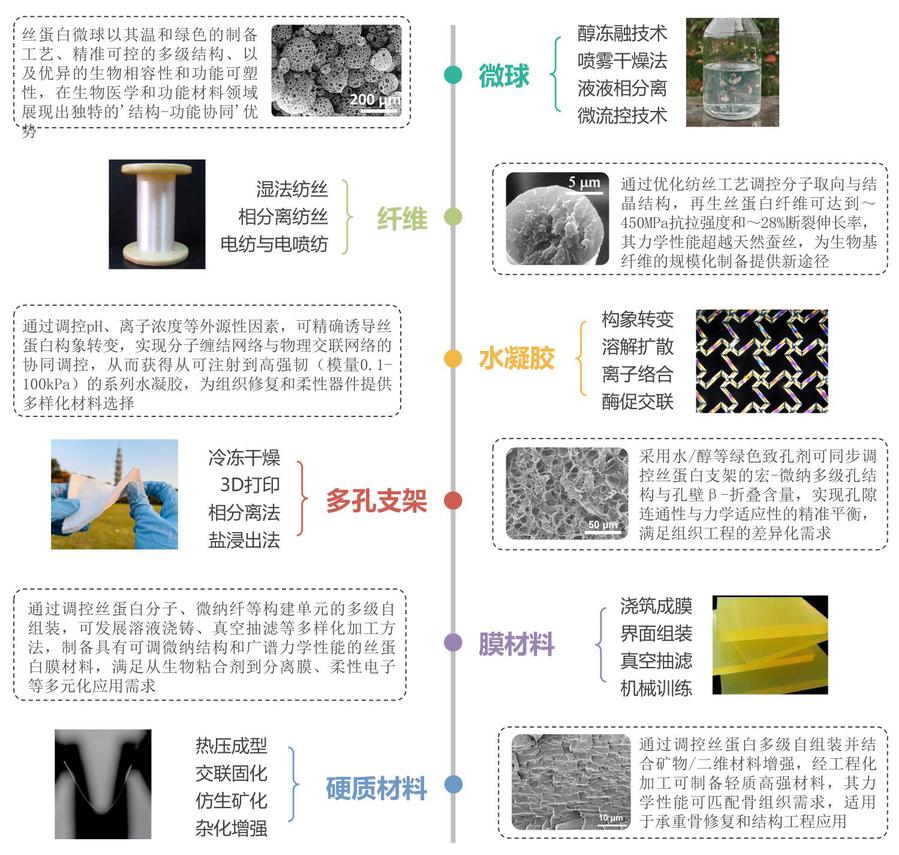
As a typical biomacromolecule, silk fibroin possesses unique multiscale structural regulation capabilities and can achieve controlled fabrication from cocoon silk fibroin into various material forms through mild and green processing methods, including microspheres, fibers, hydrogels, porous scaffolds, membrane materials, and rigid materials. Based on the molecular chain structure and self-assembly properties of silk fibroin itself, by modulating intermolecular interactions, assembly modes, and processing conditions, the structural characteristics of silk fibroin materials at nanoscale, microscale, and macroscale can be precisely controlled to achieve effective matching and optimization of morphology and mechanical properties. Furthermore, silk fibroin exhibits excellent synergistic assembly performance with other natural or synthetic polymers and inorganic materials. Through hybridization or composite assembly strategies, it is possible to further enhance or impart new functional properties to the materials while maintaining the structural advantages of silk fibroin materials, effectively meeting the application requirements for multifunctionality and high performance in fields such as tissue engineering, regenerative medicine, and biomedical devices, demonstrating the broad application potential of silk fibroin as a functional biomaterial.
Copyright © 上海复旦大学

